
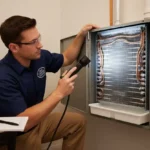
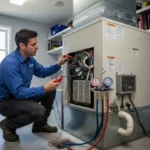


The most common evaporator coil problems are dirt buildup, freezing, refrigerant leaks, corrosion, bent fins, restricted airflow, and declining heat-transfer performance. Typical warning signs include warm air from the vents, weak cooling, ice on the indoor coil or refrigerant lines, unusually long AC cycles, water around the indoor unit, higher energy use, or a system that struggles to reach the thermostat setting.
An evaporator coil problem does not automatically mean the coil needs replacement. A dirty filter, weak blower, blocked return, incorrect refrigerant charge, condensate problem, or another HVAC fault can create similar symptoms. The first task is identifying whether the coil itself has failed or whether another part of the system is preventing it from working correctly. Related cooling, heating, maintenance, and repair topics are organized in the HVAC Guides.
Evaporator Coil Problems at a Glance
| Problem | Common warning signs | Typical repair path |
|---|---|---|
| Dirty coil | Weak cooling, long cycles, reduced airflow | Professional cleaning |
| Frozen coil | Ice, warm air, water after thawing | Find airflow or refrigerant cause |
| Refrigerant leak | Poor cooling, icing, long runtime | Leak detection and repair or coil replacement |
| Coil corrosion | Refrigerant loss, visible deterioration | Evaluate repair vs replacement |
| Bent fins | Restricted airflow across coil | Fin correction if damage is limited |
| Airflow restriction | Freezing, weak output, long cycles | Correct filter, blower, return, or duct issue |
| Repeated coil failure | Recurring leaks or cooling loss | Replacement becomes stronger |
| Incorrect coil match | Weak performance after installation | Correct equipment compatibility |
Visible symptoms overlap heavily, so the diagnosis should connect the symptom to an actual measured or observed cause before major work begins.
What the Evaporator Coil Does
The evaporator coil absorbs heat from indoor air during the refrigeration cycle. Refrigerant entering the coil changes state as it absorbs that heat, while the blower pushes household air across the coil surface and sends the cooled air through the ducts.
The process depends on three things working together: proper refrigerant flow, adequate airflow, and enough clean coil surface for heat transfer.
A problem with any one of those conditions affects the other two. Reduced airflow can make the coil excessively cold. A refrigerant leak alters coil pressure and temperature. Dirt acts as an insulating layer that interferes with heat transfer.
Different coil shapes and construction methods also affect installation and service considerations, which is why evaporator coil types and cost differences matter when a coil eventually needs major work.
Problem 1: Dirt Buildup on the Coil
Dust, pet hair, lint, and other airborne debris can reach the evaporator coil when filtration is poor or maintenance has been neglected.
A dirty coil cannot absorb indoor heat as effectively. Lennox notes that debris buildup forces the HVAC system to operate longer and harder, increasing energy use and contributing to poor performance.
Heavy buildup also interferes with airflow through the narrow spaces between coil fins.
The result can include weaker cooling, longer operating cycles, higher electricity use, and eventually coil freezing.
Minor surface contamination and deeply embedded buildup are not the same problem. Professional evaporator coil maintenance is appropriate when the coil needs cleaning without physical or refrigerant-system repair.
Problem 2: The Evaporator Coil Freezes
Ice on the evaporator coil is a symptom, not a diagnosis.
Trane identifies restricted airflow as one of the leading causes of a frozen coil. Dirty filters, blocked return vents, dirty coil surfaces, low refrigerant, and thermostat-related problems all contribute to freezing.
Carrier also links frozen coils with inadequate cooling, excessive condensate, and frost on refrigerant tubing.
If you see ice, turn the cooling system off. Do not chip, scrape, or pry the ice from the coil because the thin fins and refrigerant tubing can be damaged easily.
Once the ice melts, the underlying cause still needs correction. Simply restarting the AC without addressing the airflow or refrigerant problem often allows the coil to freeze again.
Problem 3: Low Airflow Across the Coil
An evaporator coil needs a steady supply of warm indoor air to remain within its intended operating temperature.
A severely clogged filter, blocked return, closed register, dirty blower, damaged duct, or failing blower motor reduces that airflow. The coil then becomes colder than intended and can begin accumulating ice.
Poor airflow also reduces the amount of conditioned air reaching the rooms.
This is why frozen-coil diagnosis should extend beyond the coil cabinet. Cleaning or replacing the coil will not correct an undersized return or damaged distribution system.
A technician should establish whether the restriction is at the filter, blower, coil, return system, or ducts before recommending expensive coil work.
Problem 4: Refrigerant Leaks
A residential air conditioner uses a sealed refrigerant circuit. Refrigerant does not disappear through normal operation.
Low refrigerant therefore points toward leakage or, in some cases, an installation charge that was incorrect from the beginning.
Trane identifies wear, corrosion, physical damage, frozen-coil damage, and installation problems among causes of refrigerant leaks. Carrier also notes that coil corrosion and vibration-related wear can create small openings in tubing.
A leak changes refrigerant pressure and can contribute to poor cooling and coil freezing.
Finding the leak matters more than adding refrigerant. A technician should locate the source and determine whether the defect can be repaired reliably or whether evaporator coil repair cost should be compared with replacement.
Problem 5: Coil Corrosion
Evaporator coils operate in a humid environment because moisture condenses on the cold coil whenever the air conditioner removes humidity from the home.
Over time, corrosion can attack coil tubing and create pinhole refrigerant leaks.
Carrier specifically identifies formicary corrosion as one potential source of small holes in copper coils. Chemical compounds in indoor air can contribute to reactions at the metal surface under certain conditions.
Not every discolored coil is leaking.
Professional leak detection is needed before corrosion is blamed for refrigerant loss. Once a coil has several leaking areas or widespread deterioration, repeated patching becomes less attractive.
Extensive corrosion becomes especially important when the coil is already near the later part of its service life.
Problem 6: Bent or Damaged Coil Fins
Thin metal fins increase the evaporator coil’s surface area so heat can transfer efficiently from passing air into the refrigerant.
Those fins are easy to bend.
Minor fin damage does not automatically impair the entire system. Extensive crushing, contamination, or physical deformation restricts airflow and reduces effective heat-transfer area.
Trane recommends professional attention when fin damage becomes substantial.
The cause also matters. A small area damaged during maintenance differs from a coil that has suffered broader physical damage or poor installation.
Correcting limited fin damage can restore airflow without replacing the coil. Large-scale damage combined with refrigerant leakage or corrosion creates a much stronger replacement case.
Problem 7: Warm Air Despite the AC Running
Warm or insufficiently cool air at the registers is one of the most noticeable evaporator-coil symptoms.
The coil might be dirty, frozen, leaking refrigerant, or receiving insufficient airflow.
However, the evaporator coil is only one possible cause. Compressor faults, condenser problems, duct leakage, thermostat settings, and blower issues can create similar complaints.
Start with the thermostat and filter. If those are correct, professional diagnosis should establish whether heat transfer at the indoor coil is actually abnormal.
A system that has already developed several age-related cooling problems may eventually make a complete central air conditioner replacement more sensible than repeatedly replacing major individual components.
Problem 8: Water Around the Indoor Unit
Water near an air handler or furnace-mounted coil can originate from several sources.
A frozen evaporator coil releases a large amount of water as the ice melts. A clogged condensate drain can overflow the pan. An aging or damaged drain pan can leak even when the coil itself remains healthy.
Lennox and Trane both identify frozen coils and drainage problems as common causes of indoor HVAC water leakage.
Do not assume visible water means refrigerant is leaking. Refrigerant and condensate are entirely different.
Water damage near the unit deserves prompt attention because it can affect insulation, ceilings, walls, flooring, or surrounding building components even when the underlying HVAC repair is modest.
Problem 9: Repeated Freezing After the Coil Thaws
A frozen coil that returns to normal after thawing has not necessarily been repaired.
The ice disappeared because the equipment stopped cooling, not because the underlying problem disappeared.
Repeated freezing means the system still has an unresolved condition such as poor airflow, low refrigerant, a dirty coil, blower trouble, or another operating fault.
This pattern deserves a complete diagnostic visit rather than repeated thaw-and-restart cycles.
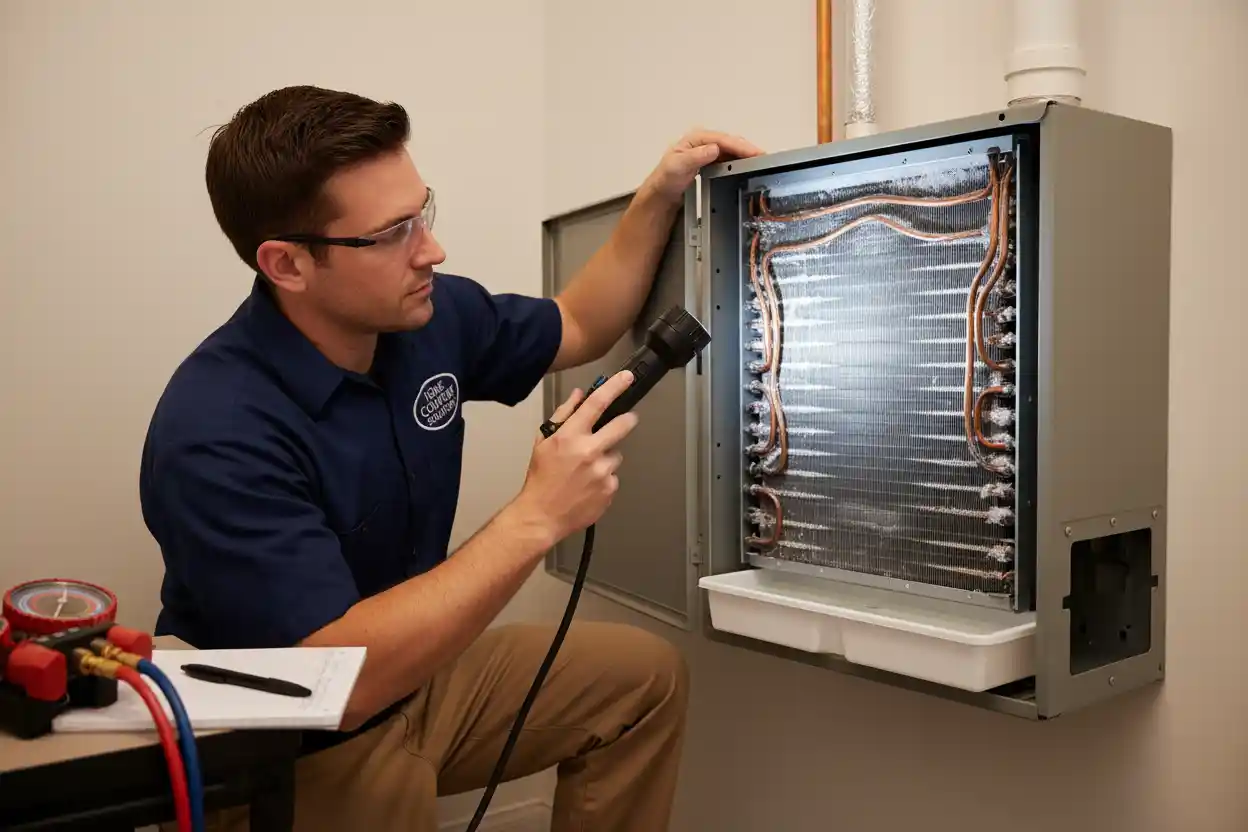
A dedicated evaporator coil inspection can evaluate coil cleanliness, physical condition, evidence of leakage, airflow, temperature behavior, drainage, and connected equipment before more serious damage develops.
Continuing to run a repeatedly frozen system can place additional stress on other HVAC components.
Problem 10: Higher Energy Use With Declining Cooling
A dirty or poorly performing coil forces the cooling system to run longer to remove the same amount of heat from the house.
Carrier lists higher utility bills among symptoms associated with frozen or malfunctioning evaporator coils, while Lennox explains that dirty coils increase operating effort and energy consumption.
An electricity bill alone cannot diagnose a coil.
Outdoor temperatures, thermostat settings, insulation, duct leakage, equipment efficiency, household occupancy, and electricity rates all affect total energy use.
The evidence becomes more convincing when higher consumption appears alongside longer cooling cycles, poor temperature control, weak airflow, or visible icing.
Diagnosis should connect those symptoms to measured system performance before any coil is condemned.
Problem 11: The Coil Keeps Developing Refrigerant Leaks
One repairable leak does not necessarily justify coil replacement.
Repeated leaks change the decision.
Multiple leak locations suggest that the tubing or joints have deteriorated beyond one isolated weak point. Repairing one area offers limited value when another section is likely to fail soon.
Coil age matters as well. Carrier states that reliable evaporator coils often last around 10 to 15 years, with maintenance and operating conditions affecting actual life.
A recurring leak on a relatively young coil deserves investigation into installation quality and the specific failure. Multiple leaks on an older coil make evaporator coil replacement cost much more relevant.
Problem 12: The Indoor Coil Does Not Match the Outdoor Equipment
An evaporator coil and outdoor condenser or heat pump must operate as a compatible refrigeration system.
Installing an incorrect coil can affect capacity, efficiency, refrigerant behavior, airflow, and equipment ratings.
This problem becomes relevant after partial system replacements, major repairs, or installations where indoor and outdoor components were selected separately.
Matching goes beyond physical size.
Capacity, refrigerant requirements, metering devices, airflow, controls, and manufacturer-approved combinations all matter.
When the coil itself must be added or changed as part of a larger project, understanding evaporator coil installation cost helps separate new-installation work from repairs to an existing matched system.
Dirty Filters and Dirty Coils Are Connected Problems
The air filter exists partly to protect indoor HVAC components from airborne contamination.
A neglected filter first restricts airflow. As debris bypasses or overwhelms filtration, more contamination can reach the coil.
That creates a double problem: less air moves across a surface that is itself becoming less effective at transferring heat.
Regular filter replacement therefore protects more than indoor air cleanliness.
It helps preserve coil performance, blower operation, and normal refrigeration conditions.
Filter replacement remains a homeowner maintenance task when the filter is safely accessible. Deep coil cleaning is different because aggressive brushing, harsh chemicals, or physical contact can damage fins and tubing.
Professional cleaning makes sense when significant buildup has already reached the coil.
A Refrigerant Leak Should Not Be Solved With Repeated Recharging
Adding refrigerant restores charge temporarily but does not repair the opening that allowed refrigerant to escape.
A properly operating sealed system should not need routine refrigerant refills.
Repeated recharging allows the leak to continue while the system cycles between acceptable and inadequate refrigerant levels.
That creates poor cooling and can expose the compressor to abnormal operating conditions.
The durable approach is leak detection followed by a repair decision based on the leak location, coil condition, equipment age, refrigerant requirements, and reliability of the proposed correction.
If the coil itself is repeatedly leaking, comparing evaporator coil repair versus replacement provides a clearer decision than paying for another temporary recharge.
Odors Need Careful Diagnosis
Unusual odors from the HVAC system can coincide with moisture and contamination around the indoor coil, drain pan, filter, or nearby duct surfaces.
The smell does not identify the source.
Standing condensate, dirty filters, accumulated debris, wet insulation, drainage problems, and other conditions around the indoor equipment can all create odors.
A technician should inspect the coil cabinet and moisture-management components rather than assuming the coil itself needs replacement.
Visible or suspected microbial growth also deserves careful handling. The priority is identifying the moisture source and affected surfaces, not masking the odor.
Correct drainage and normal coil operation are necessary if the problem is expected to stay resolved.
When Cleaning Is Enough
Cleaning makes sense when contamination is the main defect and the coil remains structurally sound.
The technician removes dirt without damaging fins or tubing, restores the filter and airflow conditions that allowed buildup to occur, and verifies normal cooling afterward.
Cleaning does not fix corrosion, refrigerant leaks, damaged tubing, severe fin destruction, or a mismatched coil.
That distinction prevents maintenance from being sold as a repair for physical failure.
Professional evaporator coil service is also useful when the homeowner needs testing, cleaning, operational checks, or system-specific adjustment rather than replacement of the coil itself.
The appropriate service should match the defect that was actually found.
When Coil Repair Makes Sense
Repair has the strongest case when the coil is relatively young, the defect is isolated, compatible parts and refrigerant are readily available, and the rest of the HVAC system remains healthy.
A localized connection leak, limited physical damage, drainage-related issue, or correctable airflow problem does not justify discarding a complete coil automatically.
Warranty coverage also matters.
A covered component shifts the economics toward repair because the homeowner may owe primarily labor and supporting service expenses.
Ask for the diagnosis in writing when substantial refrigerant work is proposed.
The contractor should be able to explain where the failure occurred, whether it can be corrected reliably, and what warranty applies to the completed repair.
When Coil Replacement Makes More Sense
Replacement becomes stronger when the coil has widespread corrosion, multiple refrigerant leaks, severe physical damage, recurring freezing tied to coil failure, or repeated repairs that no longer produce reliable operation.
System age then becomes important.
Installing a new coil into old outdoor equipment deserves a compatibility check, particularly if the condenser or heat pump is also near the end of its expected life.
The new coil needs to work correctly with the refrigerant, capacity, metering device, blower, and outdoor unit.
A complete diagnosis should therefore look beyond whether a replacement coil physically fits inside the cabinet.
Compatibility and remaining system life determine whether the investment makes sense.
Heat Pump Coils Work During More Than One Season
A heat pump uses its indoor coil as part of both heating and cooling operation.
That means coil condition affects year-round comfort rather than summer cooling alone.
Restricted airflow, refrigerant leaks, dirty surfaces, or physical damage can interfere with either operating mode.
Homes considering major heat-pump work should therefore evaluate the indoor coil as part of the complete system rather than as an unrelated AC component.
When several heat-pump components need substantial work at the same time, comparing the complete heat pump installation cost can provide better context than replacing individual aging components one after another.
Ductless Systems Use Evaporator Coils Too
Every ductless indoor head contains an evaporator coil during cooling operation.
The coil sits directly in the room unit rather than inside a central air handler or furnace-mounted cabinet.
Dirt accumulation, freezing, refrigerant leaks, drainage problems, and fin damage can therefore affect ductless equipment as well.
The repair decision differs because one multi-zone system can contain several indoor coils connected to a single outdoor unit.
Failure of one indoor head does not automatically require replacing every zone.
Owners of aging ductless equipment facing repeated coil or refrigeration faults can compare the broader mini split repair versus replacement decision before committing to major work.
What Homeowners Can Check Safely
Several useful checks do not require opening refrigeration or electrical components.
Confirm that the thermostat is set correctly. Inspect the accessible air filter and replace it if heavily clogged. Look for visible frost on accessible refrigerant tubing, obvious water around the indoor unit, or severely blocked return and supply registers.
If the coil is frozen, turn cooling off and allow it to thaw naturally.
Do not chip ice from the coil. Do not open sealed refrigeration connections, add refrigerant, bend tubing, or handle internal electrical components.
When symptoms return after basic airflow issues have been corrected, professional diagnosis should determine whether the problem belongs to the coil or another part of the HVAC system.
Conclusion
Evaporator coil problems rarely exist in isolation. Dirt, airflow, refrigerant charge, corrosion, drainage, blower operation, and equipment compatibility all affect how the coil performs. Frozen coils and weak cooling deserve diagnosis before replacement, while recurring refrigerant leaks, widespread corrosion, severe physical damage, and repeated failures create a stronger case for a new coil. Correct the cause as well as the damaged component so the same operating problem does not return.
Frequently Asked Questions
What is the most common evaporator coil problem?
Dirt buildup and airflow restriction are among the most common problems associated with poor coil performance and freezing. Dirty filters are a frequent starting point because they reduce airflow before air reaches the coil.
Should I turn the AC off if the evaporator coil is frozen?
Yes. Trane and Carrier advise shutting cooling off when the evaporator coil is frozen. Let the ice thaw naturally and have the underlying airflow or refrigerant problem diagnosed.
Does a frozen coil mean the refrigerant is low?
Not always. Low refrigerant is one possible cause, but dirty filters, blocked returns, dirty coil surfaces, and blower or airflow problems also cause evaporator coils to freeze.
Can an evaporator coil refrigerant leak be repaired?
Some isolated leaks can be repaired, depending on their location and the condition of the surrounding tubing. Widespread corrosion or repeated leaks make complete coil replacement more practical.
How long does an evaporator coil normally last?
A useful planning range is roughly 10 to 15 years, although installation quality, operating conditions, corrosion, maintenance, airflow, and equipment quality affect actual service life.
Why is water leaking around my evaporator coil?
A frozen coil can release substantial water while thawing. Clogged drain lines, cracked drain pans, and other condensate problems also cause water around indoor HVAC equipment.
Can a dirty evaporator coil damage the compressor?
A dirty coil interferes with airflow and heat transfer, which can create abnormal system operating conditions. Severe or prolonged problems increase stress on connected HVAC components, including the compressor.