
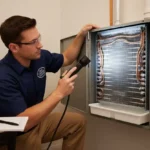
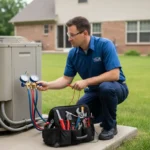
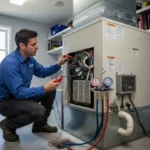
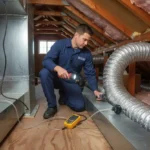


The strongest signs an AC compressor may need replacement are no cooling despite the system running, repeated hard starts, loud grinding or banging from the outdoor unit, frequent breaker trips, compressor overheating, repeated shutdowns, and a professional diagnosis confirming internal mechanical or electrical failure. One symptom alone does not prove the compressor is bad because failed capacitors, contactors, condenser fans, wiring problems, refrigerant faults, and airflow restrictions can produce similar symptoms.
The compressor is one of the most important and expensive components in a central air conditioner. It pressurizes refrigerant so heat can move from inside the home to the outdoor condenser. When the compressor truly fails, normal cooling stops. Because several smaller faults can imitate compressor failure, replacement should follow diagnostic testing rather than symptoms alone. Related cooling, heating, repair, and replacement topics are organized within the HVAC Guides.
AC Compressor Replacement Signs at a Glance
| Warning sign | What it can indicate | Does it prove compressor failure? |
|---|---|---|
| AC runs but does not cool | Compressor, refrigerant, airflow, coil, or control problem | No |
| Compressor will not start | Capacitor, contactor, wiring, thermostat, safety control, or compressor | No |
| Grinding or banging outside | Internal compressor damage or another mechanical fault | Strong concern |
| Repeated breaker trips | Excess current, shorted motor, electrical fault, or compressor problem | Strong concern |
| Outdoor unit overheats | Compressor strain, fan failure, dirty coil, electrical or refrigerant issue | No |
| Hard starting or repeated start attempts | Capacitor, voltage, control, or compressor wear | No |
| Cooling capacity steadily declines | Refrigerant, coil, airflow, or compressor deterioration | No |
| Technician confirms failed windings or internal mechanical damage | Compressor failure | Yes |
| Major compressor failure on an older AC | Low remaining system value | Replacement decision required |
The most important distinction is between a symptom and a confirmed failure. Homeowners can recognize symptoms, but compressor diagnosis requires professional electrical and refrigeration testing.
What the AC Compressor Actually Does
The compressor sits inside the outdoor condenser and drives the refrigeration cycle.
Low-pressure refrigerant vapor returns from the indoor evaporator coil. The compressor raises that vapor to a high pressure and temperature so the refrigerant can release absorbed indoor heat through the condenser coil outside.
Without effective compression, the system cannot maintain the pressure difference required for normal cooling.
That is why complete compressor failure stops the refrigeration cycle even when the thermostat, indoor blower, or outdoor fan still operates.
Different AC systems use reciprocating, scroll, rotary, variable-speed, or other compressor designs. Their operation and replacement complexity differ, which is why AC compressor types and cost differences matter once diagnosis moves beyond the initial symptoms.
Sign 1: The AC Runs but the House Does Not Cool
An air conditioner that operates without reducing indoor temperature deserves prompt diagnosis.
A failed compressor is one possible cause because refrigerant cannot circulate through the system correctly without adequate compression. Carrier and Lennox both identify loss of cooling as a common compressor-failure symptom.
It is not proof.
Low refrigerant charge, a refrigerant leak, frozen evaporator coil, clogged filter, failed condenser fan, dirty coil, thermostat issue, damaged ductwork, or electrical control problem can also reduce cooling.
Check whether the thermostat is set correctly and whether the filter is severely restricted. Do not open electrical panels or refrigerant components.
If basic settings appear normal and the system still fails to cool, a professional AC compressor inspection should establish whether the compressor or another component is responsible.
Sign 2: The Compressor Will Not Start
A compressor that does not start is a serious symptom, but several less expensive components can prevent it from receiving the power or control signal it needs.
Trane identifies thermostat problems, tripped breakers, faulty capacitors, loose electrical connections, and compressor-motor failure among the reasons a compressor might not start. Carrier also points to contactors, capacitors, refrigerant-related safety controls, wiring, and power problems.
That means “compressor not running” does not equal “compressor needs replacement.”
A technician needs to determine whether the compressor receives the correct voltage and control signal and whether its motor windings and internal protection operate correctly.
Replacing a compressor before checking the starting circuit risks replacing the most expensive component when the actual fault is a much smaller electrical part.
Sign 3: Loud Grinding, Banging, or Severe Mechanical Noise
A healthy compressor produces a consistent operating sound rather than loud grinding, clattering, banging, or screeching.
Carrier and Trane both identify abnormal outdoor-unit noises as possible signs of compressor or other mechanical failure.
The type and location of the noise matter.
A loose condenser-fan blade, failing fan motor, contactor, cabinet vibration, or debris can create noise outside without damaging the compressor. Internal grinding or heavy mechanical knocking originating from the compressor shell creates much greater concern.
Turn the system off when severe mechanical noise begins suddenly. Continuing to run equipment with a confirmed mechanical failure can increase damage.
The technician should identify exactly which component produces the sound before recommending an expensive repair.
Sign 4: The Circuit Breaker Trips Repeatedly
A compressor draws substantial electrical current, especially during startup.
Repeated breaker trips can indicate an overloaded or electrically damaged compressor. Carrier lists frequent breaker trips among the warning signs of compressor trouble, while Trane notes that compressor-motor or other electrical faults can prevent normal operation.
One breaker trip still does not diagnose the compressor.
Condenser-fan problems, damaged wiring, capacitor faults, short circuits, loose electrical connections, and other equipment failures can trip the same circuit.
Do not repeatedly reset a breaker that continues to trip. The breaker is responding to an electrical condition that needs diagnosis.
High-voltage HVAC electrical work belongs with a qualified technician. Repeatedly energizing faulty equipment can damage components and create an electrical hazard.
Sign 5: The Compressor Hard Starts or Struggles to Start
A hard-starting compressor hesitates, hums, attempts to start repeatedly, or draws unusually high current before operating.
Compressor wear can cause hard starting, but the starting components deserve testing first.
The capacitor provides electrical assistance during motor startup. A weakened or failed capacitor can leave a healthy compressor unable to start. Contactor problems, low voltage, wiring faults, and control issues produce similar behavior.
Professional testing separates a failing compressor motor from a failed starting component.
This distinction matters financially because replacing a capacitor or contactor is a very different project from compressor replacement.
If testing confirms that the compressor itself remains functional, the expected AC compressor repair cost depends on which supporting component needs correction rather than on replacing the compressor assembly.
Sign 6: The Outdoor Unit Overheats or Shuts Down
Excessive compressor temperature can trigger internal protection and shut the system down.
Carrier includes overheating and premature shutdown among signs associated with compressor failure. Heat does not identify the root cause by itself.
A dirty condenser coil restricts heat rejection. A failed condenser fan prevents normal airflow. Low refrigerant, improper refrigerant charge, voltage problems, or severe outdoor operating conditions also increase compressor stress.
Repeated overheating deserves investigation because prolonged thermal stress damages compressor windings and internal mechanical components.
Cleaning accessible debris from around the outdoor cabinet is reasonable homeowner maintenance. Opening service panels, testing electrical components, or connecting refrigerant gauges is not.
A compressor repeatedly entering thermal protection needs professional diagnosis before normal operation resumes.
Sign 7: Cooling Performance Keeps Declining
Compressor deterioration can reduce the system’s ability to maintain the pressure difference required for effective cooling.
The result can look like gradually weaker cooling rather than a sudden complete failure.
Rooms take longer to cool, the air conditioner runs for extended periods, and the thermostat struggles during conditions the system previously handled.
Several other problems create exactly the same pattern.
Dirty coils, duct leakage, airflow restrictions, refrigerant leaks, aging blower components, insulation changes, and unusually high outdoor temperatures all affect cooling capacity.
A technician should measure operating conditions rather than declaring the compressor weak from runtime alone.
Declining performance becomes much stronger evidence when testing confirms poor compressor pumping ability after airflow, refrigerant charge, electrical supply, and coil condition have been evaluated.
Sign 8: The Compressor Repeatedly Stops and Restarts
Frequent compressor cycling can reflect incorrect system sizing, thermostat problems, high pressure, low pressure, electrical controls, refrigerant conditions, overheating, or internal compressor protection.
A compressor protecting itself from abnormal conditions might stop even though the compressor itself is not the original problem.
For example, a failed condenser fan can cause pressure and temperature to rise until the system shuts down. Replacing the compressor without correcting the fan would leave the original cause untouched.
Repeated cycling therefore needs system-level diagnosis.
A professional AC compressor service visit should evaluate the conditions causing shutdown rather than simply restarting the equipment.
Patterns matter. Note how long the AC runs before stopping and whether the indoor blower or outdoor fan continues operating.
Sign 9: The Technician Finds Failed Motor Windings
Electrical testing provides much stronger evidence than comfort symptoms.
A compressor motor contains windings inside its sealed shell. A technician can test electrical resistance and insulation condition to identify open, shorted, or grounded windings.
Confirmed winding failure points directly toward compressor replacement because the sealed compressor motor cannot be repaired like an external wire or contactor.
This is also why compressor diagnosis is not a homeowner electrical project.
The equipment operates at dangerous voltage, capacitors can retain electrical charge, and compressor terminals require appropriate test procedures.
When a technician identifies an internal electrical failure, ask for the diagnostic explanation and warranty status before approving replacement.
The diagnosis should distinguish internal compressor failure from external wiring or start-component problems.
Sign 10: Internal Mechanical Failure Is Confirmed
A compressor can suffer internal valve, bearing, scroll, piston, or other mechanical damage depending on its design.
The result might be severe noise, inability to create proper refrigerant pressure, overheating, or complete seizure.
Internal mechanical failure usually means replacing the compressor rather than repairing individual parts inside its sealed shell.
The next question becomes whether replacing only the compressor makes financial sense.
A young central AC with a healthy coil, condenser, controls, and strong warranty coverage presents a better compressor-replacement case than an old system with widespread wear.
The expected AC compressor replacement cost should therefore be considered alongside system age, warranty, refrigerant compatibility, and the condition of the remaining equipment.
Warm Air Does Not Automatically Mean a Bad Compressor
Warm air at the registers is one of the easiest symptoms to misinterpret.
The thermostat may be set incorrectly. The outdoor unit might have lost power. A dirty filter can restrict airflow. An evaporator coil can freeze. Refrigerant can leak. The condenser fan can fail.
The compressor is only one possibility.
Check the thermostat setting and filter before scheduling service. If a breaker has tripped repeatedly, leave the equipment off and have the electrical fault investigated rather than continuing to reset it.
Avoid adding refrigerant or opening the condenser cabinet.
A compressor diagnosis becomes credible only after the technician rules out the simpler failures that can prevent an otherwise healthy compressor from cooling the house.
A Failed Capacitor Can Look Like a Failed Compressor
Capacitors help HVAC motors start and run.
When a compressor capacitor fails, the outdoor unit might hum, struggle to start, shut down, or appear completely dead.
Those symptoms overlap heavily with compressor failure.
Carrier and Trane both identify capacitor problems as a common reason a compressor fails to start even when the compressor motor itself has not failed.
This is one of the strongest reasons to avoid symptom-only replacement decisions.
A technician can test the capacitor separately and verify whether the compressor starts correctly with functioning electrical components.
Capacitors also store potentially dangerous electrical energy after the system is disconnected, so opening the condenser and handling them is not a safe homeowner diagnostic step.
A Failed Condenser Fan Can Overheat a Good Compressor
The outdoor fan moves air across the condenser coil so refrigerant can release heat.
If that fan stops, heat and refrigerant pressure rise. The compressor can overheat or shut down even though its internal components were originally healthy.
Carrier identifies fan failure, capacitor problems, and compressor failure as separate causes of outdoor-unit malfunction.
Observe the unit from a safe distance. If the AC is calling for cooling but the fan is not operating, shut the system down and schedule diagnosis.
Do not reach into the fan area or attempt to start the blade manually.
Correcting a failed fan motor or capacitor early protects the compressor from additional thermal stress.
Refrigerant Problems Can Mimic Compressor Failure
Refrigerant pressure and compressor operation are closely connected.
A leak lowers refrigerant charge and reduces cooling performance. In some systems, protective controls stop compressor operation when pressure falls outside the safe range.
An overcharged system or refrigerant restriction can create harmful operating pressures in the opposite direction.
That is why cooling performance and compressor condition cannot be evaluated properly without considering the refrigerant circuit.
Refrigerant is not a consumable that should require routine topping up. A low charge indicates a leak or another service issue that needs correction.
Only properly qualified technicians should handle refrigerant. Adding refrigerant without locating the underlying problem does not provide a durable repair and can expose the compressor to continued abnormal operation.
Age Matters After Compressor Failure Is Confirmed
Compressor failure on a younger central AC creates a different decision from compressor failure on equipment that has already served for many years.
Carrier and Lennox both advise considering complete system age when deciding whether compressor replacement remains worthwhile. Lennox specifically identifies systems beyond roughly 10 to 15 years as stronger candidates for complete replacement when the compressor has failed.
Age is not the only factor.
Warranty coverage, refrigerant type, coil condition, condenser condition, prior repairs, efficiency, and the price difference between compressor work and complete AC replacement all affect the decision.
For an aging system, compare AC compressor repair versus replacement after the failure has been verified rather than applying a universal age cutoff.
Warranty Coverage Can Make Compressor Replacement Sensible
Compressors often carry longer parts warranties than some other HVAC components.
A covered compressor changes the economics substantially because the manufacturer supplies one of the most expensive parts.
The homeowner can still owe labor, refrigerant, recovery, shipping, filter-drier replacement, related materials, and other installation charges.
Check warranty status before deciding that complete AC replacement is necessary.
Ask the contractor to show which portion of the estimate is covered and which portion remains out of pocket.
A young system with a covered compressor and healthy remaining components presents one of the strongest cases for component replacement rather than replacing the entire cooling system.
Replacing a Compressor Is More Than Swapping One Part
The compressor is part of a sealed refrigeration circuit.
Replacement requires refrigerant recovery, removal of the failed compressor, installation of the compatible replacement, brazing or other approved connections, replacement of appropriate refrigeration components, evacuation, leak checking, refrigerant charging, electrical work, startup, and performance testing.
Contamination after certain compressor failures can add further procedures.
This work explains why compressor replacement carries substantial labor even when the part itself has warranty coverage.
The complete project scope is different from installing a minor external component. Homeowners comparing quotes should understand what is included in the AC compressor installation cost rather than judging the compressor price alone.
Whole-System Replacement Can Be Better on an Aging AC
A new compressor does not make the remaining air conditioner new.
The condenser coil, fan motor, contactor, capacitor, evaporator coil, refrigerant lines, controls, and connected indoor equipment retain their existing age.
That matters when an old system experiences one of its most expensive component failures.
If several parts are already deteriorating, putting a new compressor into the old equipment can preserve only part of the system’s value.
The broader central air conditioner replacement cost becomes relevant once compressor replacement is compared with an entirely new matched cooling system.
The decision should consider future reliability and remaining component life as well as today’s repair invoice.
Heat Pumps Use Compressors Too
A heat pump relies on a compressor for both cooling and heating.
Compressor symptoms therefore appear in either operating mode. A failed heat-pump compressor can leave the home without normal cooling in summer and without normal heat-pump heating in winter.
The same diagnostic principle applies: poor heating or cooling does not automatically prove compressor failure.
Controls, reversing valves, refrigerant problems, outdoor fans, sensors, electrical components, airflow, and backup heat can create different symptoms.
When major failure occurs in an aging heat pump, comparing the complete heat pump installation cost may make more sense than treating the compressor as a cooling-only component.
Maintenance Protects the Compressor From Avoidable Stress
Routine maintenance cannot prevent every compressor failure.
It can reduce operating conditions that shorten compressor life.
Clean condenser coils reject heat more effectively. Correct airflow protects refrigerant conditions. Electrical inspection catches weak connections and failing components. Refrigerant-system diagnosis identifies abnormal operation before prolonged stress creates larger damage.
Keeping the outdoor unit clear of debris also helps maintain normal airflow.
A planned AC compressor maintenance cost should be understood as part of wider AC maintenance rather than as opening and servicing the sealed compressor internally.
The goal is to keep the system around the compressor operating under the conditions the compressor was designed to handle.
What to Do When You Suspect Compressor Failure
Start with the safe checks.
Confirm that the thermostat is set to cooling and below the indoor temperature. Look at the air filter and replace it if it is severely dirty. Check whether the outdoor unit is operating from a safe distance.
Stop there when the problem points toward the condenser, refrigerant circuit, or electrical system.
Do not open the outdoor service panel, handle capacitors, repeatedly reset a tripping breaker, connect refrigerant gauges, or attempt to bypass controls.
If the system makes severe mechanical noise, repeatedly trips the breaker, produces a burning odor, or rapidly overheats, shut it down and arrange professional diagnosis.
The objective is to identify the failed component before further operation creates additional damage.
When a Different HVAC System Becomes Worth Considering
A confirmed compressor failure on aging equipment creates an opportunity to reconsider how the home is heated and cooled.
Some homeowners replace central AC with another conventional system. Others evaluate a heat pump because it combines heating and cooling.
Homes without useful ducts or properties needing independent room control can consider ductless equipment, although that involves a different system design and cost structure. Existing ductless owners can use the mini split repair versus replacement decision framework when their own compressor or outdoor unit fails.
If the house uses a furnace for heating, keep its condition separate from the cooling diagnosis. An independent furnace repair cost should not be folded into an AC compressor diagnosis unless the heating equipment has its own confirmed fault.
Conclusion
The most convincing signs an AC compressor needs replacement appear when symptoms are backed by diagnostic evidence. No cooling, hard starting, severe mechanical noise, repeated breaker trips, overheating, and frequent shutdowns justify professional testing, but capacitor, fan, refrigerant, wiring, and airflow faults can imitate compressor failure. Replace the compressor only after the failure is confirmed, then use system age, warranty coverage, remaining equipment condition, and replacement alternatives to decide whether the compressor or the complete AC system deserves the investment.
Frequently Asked Questions
Can an AC compressor be bad even if the outdoor fan still runs?
Yes. The condenser fan and compressor use separate motors. The fan can operate while the compressor has an electrical or mechanical failure, leaving the system unable to cool properly.
Does warm air mean the compressor has failed?
No. Warm air can result from thermostat settings, low refrigerant, frozen coils, airflow restrictions, electrical problems, or other faults. Compressor failure is one possible cause.
Should I keep resetting the breaker if the AC trips it?
No. Repeated trips indicate an electrical or equipment fault. Continuing to reset the breaker without correcting the cause can damage the system and creates a safety concern.
Can a bad capacitor stop the compressor from starting?
Yes. A failed start or run capacitor can prevent compressor startup and create symptoms that resemble compressor failure. A technician can test the capacitor separately.
Can low refrigerant damage a compressor?
Operating with abnormal refrigerant conditions can place harmful stress on the compressor. Low charge also indicates a leak or another refrigerant-system problem that requires professional diagnosis.
Is compressor noise always a replacement sign?
No. Outdoor-unit noise can originate from the fan, cabinet, electrical components, or other parts. Severe internal grinding, banging, or mechanical damage confirmed at the compressor creates a much stronger replacement case.
Should I replace the entire AC if the compressor fails?
Not automatically. Compressor replacement makes more sense on younger equipment with strong warranty coverage and healthy remaining components. Complete system replacement becomes more competitive when the AC is older, has repeated failures, or contains several other deteriorating components.