


Plan on about 15 years of service from a residential air handler. A well-installed and regularly maintained unit commonly reaches 15 to 20 years, while favorable conditions can push some systems beyond 20 years. Poor airflow, neglected maintenance, chronic moisture, heavy year-round use, installation defects, and repeated component failures shorten that lifespan.
An air handler is the indoor equipment that moves conditioned air through many central AC and heat-pump systems. It commonly contains the blower, evaporator coil, filter section, controls, condensate components, and sometimes electric auxiliary heat. Because several important components operate inside one cabinet, the useful life of an air handler depends on more than whether the blower still turns. Its condition affects airflow, comfort, humidity control, and the performance of the home’s wider HVAC Guides.
Air Handler Lifespan at a Glance
| Air handler condition | Practical lifespan guidance |
|---|---|
| Replacement-planning benchmark | About 15 years |
| Well-maintained residential unit | 15 to 20 years |
| Favorable installation and operating conditions | 20+ years possible |
| Heavy use or poor maintenance | Failure may occur closer to 10 to 15 years |
| Under 10 years with one isolated fault | Repair usually deserves priority |
| 15+ years with a major repair | Compare repair and replacement |
| 20+ years with declining performance | Replacement planning becomes prudent |
These ages are planning ranges, not expiration dates. A quiet, dry, well-maintained 18-year-old unit can remain useful, while a much younger air handler with coil corrosion, chronic drainage problems, poor airflow, and repeated motor failures can become a poor repair candidate.
What Manufacturer Guidance Says About Air Handler Life
Carrier states that an air handler commonly lasts 15 to 20 years with proper maintenance and gives a broader 15 to 25 year range for residential equipment under favorable conditions. Trane says homeowners can expect a new residential air handler to last 15 years or more with regular maintenance, while other Trane technical guidance places many home air handlers around the 10 to 15 year range.
Those figures point to the same practical conclusion: 15 years is the point when replacement planning should begin, not the date when the equipment must be removed.
Installation quality, operating hours, climate, airflow, drainage, coil condition, maintenance, and component quality explain why one air handler reaches its twenties while another develops expensive problems much sooner.
What an Air Handler Actually Does
The air handler moves air across the indoor coil and through the home’s ducts.
During cooling, the evaporator coil absorbs heat from indoor air. A heat-pump system uses that same indoor equipment during heating. The blower supplies the airflow needed for both processes, while filters, controls, drain components, electrical parts, and sometimes heat strips support operation.
This workload explains why air-handler condition matters to the entire HVAC system.
A weak blower, dirty coil, blocked drain, failing control board, or airflow restriction affects more than one cabinet. Comfort, energy use, humidity, heating performance, and cooling output can all suffer.
Different blower and equipment designs also create different ownership characteristics, which makes air handler types and cost differences useful when replacement eventually becomes necessary.
A Good Installation Gives the Air Handler Its Best Chance
Useful life starts on installation day.
An air handler needs correct capacity, adequate airflow, compatible outdoor equipment, properly designed drainage, sound electrical connections, sealed duct transitions, correctly configured controls, and suitable refrigerant-system setup.
Poor installation creates long-term stress. An oversized or undersized system operates under conditions that compromise comfort. Restricted returns force the blower to work harder. Incorrect drainage exposes the cabinet to water. Improper refrigerant conditions affect the evaporator coil and connected outdoor system.
A new unit installed into an unresolved HVAC problem does not receive a fresh start.
When a home is adding indoor HVAC equipment rather than making a direct swap, the broader air handler installation cost reflects the extra work required to establish those supporting conditions correctly.
Maintenance Is One of the Strongest Lifespan Factors
Air handlers move large amounts of air, so cleanliness and airflow matter throughout their service life.
Filters protect the blower and evaporator coil from excessive dirt accumulation. Drain maintenance prevents condensate backups. Coil cleaning supports heat transfer. Electrical inspections identify deteriorating connections. Blower checks reveal developing motor or wheel problems.
Regular air handler maintenance does not guarantee that the equipment will reach a specific age, but it removes several preventable causes of early deterioration.
Neglect produces the opposite effect. Dirty filters increase resistance, dirty coils reduce performance, blocked drains introduce water, and ignored electrical problems place more stress on expensive components.
Maintenance therefore affects both longevity and the quality of those operating years.
Filter Neglect Can Shorten Equipment Life
A clogged filter restricts the volume of air entering the air handler.
The blower then operates against higher resistance while the evaporator coil receives less airflow than the system was designed to provide. Cooling performance drops, operating time increases, and the coil becomes more vulnerable to freezing under the wrong conditions.
One dirty filter does not destroy an air handler.
Chronic neglect creates repeated stress over thousands of operating hours. It also allows dirt to accumulate on internal components that are far more difficult to clean than a replaceable filter.
Filter frequency depends on filter type, household conditions, pets, indoor dust, system runtime, and manufacturer recommendations. The important point is simple: airflow should never be allowed to deteriorate because an inexpensive maintenance item was ignored.
The Blower Motor Is a Major Wear Component
The blower motor works whenever conditioned air must move through the house.
Fixed-speed motors operate differently from variable-speed electronically commutated motors, but all blower systems eventually accumulate wear. Bearings, electronics, capacitors where used, control modules, and blower wheels can develop faults.
A blower failure on an eight-year-old air handler normally points toward repair rather than full replacement.
The same failure on an 18-year-old unit deserves a wider look at the evaporator coil, cabinet, controls, drainage system, wiring, and outdoor HVAC equipment.
This is where current air handler repair costs matter. The homeowner should compare the failed component with the remaining value of the complete system rather than judging a motor invoice in isolation.
Evaporator Coil Condition Can Decide the Unit’s Future
The evaporator coil is one of the most important components associated with an air handler.
Trane places normal evaporator-coil life around 10 to 15 years under standard usage and proper maintenance. A coil can last with the connected system, but corrosion, leaks, dirt, moisture, and operating conditions affect its lifespan.
A leaking coil on a young system can justify repair or coil replacement.
A major coil failure inside an old air handler changes the financial calculation because the homeowner is investing heavily in equipment whose blower, controls, cabinet, insulation, and electrical components have accumulated the same years of use.
Coil condition therefore carries more weight than cosmetic age. An old but sound coil supports continued operation. Severe corrosion or a confirmed refrigerant leak strengthens the case for replacement.
Moisture Problems Can Age an Air Handler Quickly
Cooling naturally produces condensate as moisture leaves the indoor air.
The drain pan and drain line must carry that water away reliably. Clogged drains, cracked pans, poor slope, damaged insulation, sweating cabinets, and overflowing condensate expose metal and nearby components to persistent moisture.
Water leaves evidence.
Rust around the pan, staining below the cabinet, recurring drain backups, damp insulation, or repeated float-switch trips indicate that moisture control deserves attention.
An isolated clogged drain is maintenance. Chronic water problems are a system condition.
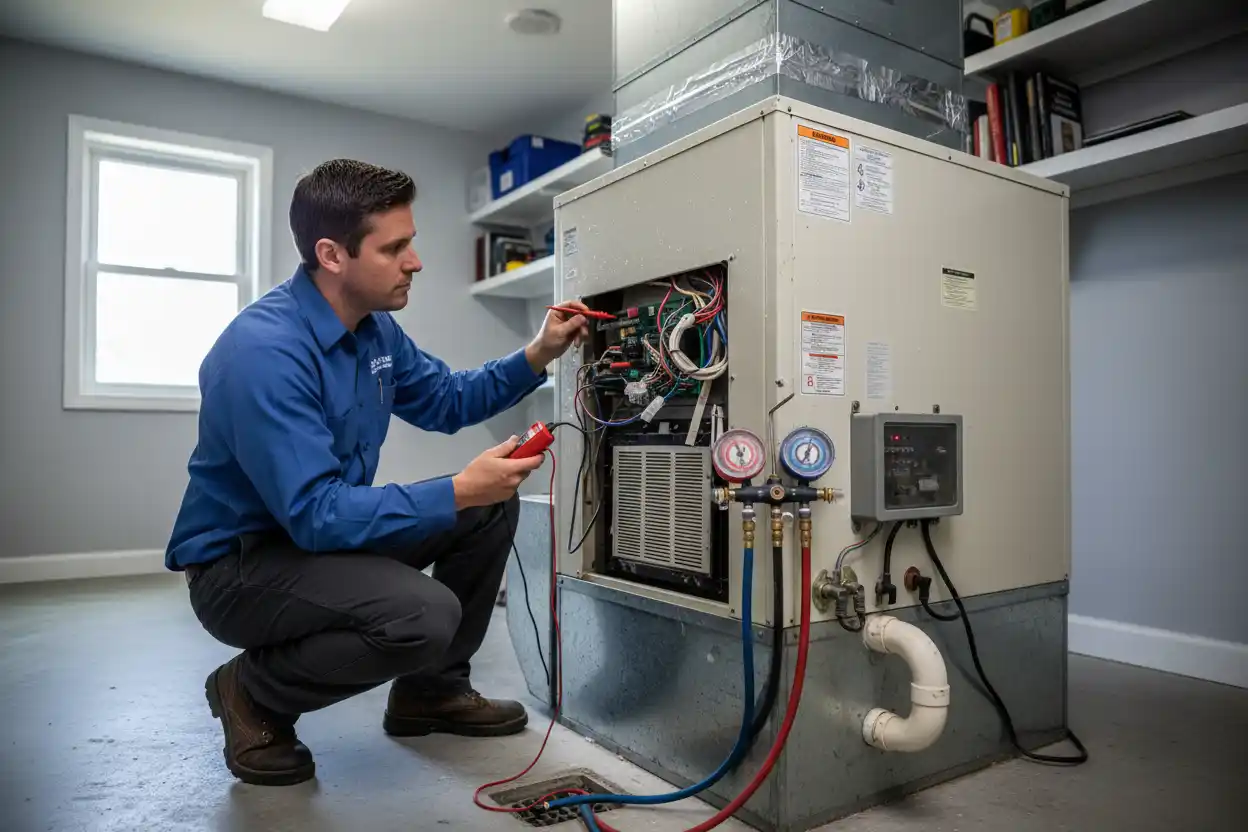
Before making a large repair decision on an older unit, an air handler inspection can document the condition of the coil, pan, cabinet, blower, controls, insulation, drainage, and other components together.
Attic and Crawlspace Units Face Harder Conditions
An air handler located in a conditioned mechanical room lives in a milder environment than equipment placed in an attic, crawlspace, garage, or other unconditioned area.
Attics expose cabinets and electrical components to high heat. Crawlspaces introduce moisture, dust, pests, and difficult access. Coastal areas increase corrosion risk where salt-laden air reaches equipment.
The installation must account for those conditions.
Attic units especially need reliable condensate protection because a drainage failure can damage both the equipment and the ceiling below. Insulation must also prevent unwanted condensation around cold surfaces.
Location does not dictate an exact lifespan, but it changes how aggressively the environment tests the equipment. Two identical air handlers can age very differently when one operates in a clean utility room and the other spends years in a hot, humid attic.
Heavy Year-Round Use Accelerates Wear
Air handlers paired with heat pumps can operate during both winter and summer.
That year-round workload gives the blower and controls more operating hours than equipment serving cooling alone in a mild climate.
Climate matters for the same reason. Homes with long cooling seasons keep the blower active for more hours. Heat-pump homes in regions with substantial winter demand add another long operating season.
Runtime does not mean the equipment is being abused. The system exists to heat and cool the house.
It does mean that two 12-year-old air handlers can have very different accumulated operating hours.
Homeowners evaluating longevity should therefore consider how hard the equipment has worked, not only the installation date.
Poor Ductwork Can Wear the Air Handler Harder
The blower depends on a properly designed supply and return network.
Restricted returns, crushed flexible ducts, closed dampers, dirty filters, blocked registers, poor balancing, and undersized duct sections increase resistance to airflow.
That creates two problems.
First, comfort suffers because conditioned air does not reach rooms properly. Second, the air handler operates under unfavorable airflow conditions.
Replacing an aging unit without correcting the duct problem exposes the new equipment to the same weakness.
Weak airflow across several rooms should therefore be diagnosed before assuming the air handler itself is at fault. A new indoor unit does not solve a distribution system that remains fundamentally restricted.
Strange Noises Need Diagnosis, Not Immediate Replacement
Squealing, grinding, rattling, buzzing, scraping, and repeated clicking each point toward different possible problems.
Blower bearings and motors can squeal or grind. Loose panels or hardware can rattle. Electrical components can buzz. Debris or damaged blower wheels can produce scraping noises.
One sound does not establish that an air handler has reached the end of its life.
The age of the equipment changes how much importance to place on the diagnosis. Replacing a motor on a younger unit is routine. Installing an expensive motor into very old equipment with a deteriorating coil and recurring electrical problems deserves more scrutiny.
Professional air handler service can separate a repairable component fault from a broader age-related decline.
Weak Airflow Is Not Automatically an Air Handler Failure
Reduced airflow is one of the most common reasons homeowners suspect the air handler.
The actual cause could be a clogged filter, dirty evaporator coil, damaged duct, closed damper, blocked return, blower fault, incorrect fan setting, or distribution problem.
That means replacing the cabinet without diagnosis can leave the symptom unchanged.
Airflow becomes a meaningful replacement sign when testing identifies declining blower performance or multiple problems inside an older air handler.
Look for combinations rather than one symptom: weak airflow plus unusual motor noise, frequent repairs, deteriorating coil condition, and advanced age tells a much stronger story than weak airflow alone.
A diagnosis should establish where the restriction or loss occurs before replacement money is committed.
Rising Energy Bills Need Supporting Evidence
An aging air handler can contribute to higher energy use when the blower loses efficiency, the coil becomes dirty, airflow deteriorates, or controls no longer operate correctly.
The utility bill cannot identify those failures by itself.
Weather, thermostat settings, insulation, electricity rates, duct leakage, outdoor HVAC efficiency, occupancy, and household habits also affect energy consumption.
Energy use becomes a stronger replacement signal when it rises alongside longer runtime, poor comfort, weak airflow, abnormal noise, or repeated repairs.
A single expensive electricity bill should trigger investigation, not automatic equipment replacement.
This distinction prevents homeowners from replacing functioning equipment in an attempt to solve a problem originating elsewhere in the house.
Frequent Repairs Are More Important Than the Calendar
Age provides context. Repair history provides evidence.
A 17-year-old air handler that has needed one minor part in several years can remain financially sensible to operate. A 12-year-old unit that has already needed a blower motor, control board, coil work, and recurring drainage repairs presents a weaker future outlook.
Review several years of service records when possible.
Several moderate repairs can consume more money than one dramatic invoice while creating continuing uncertainty.
Once failures begin spreading across unrelated components, comparing air handler repair versus replacement provides a more useful decision framework than asking whether the newest individual repair is affordable.
Reliability trends matter more than a birthday alone.
Under 10 Years Old Usually Favors Repair
An air handler under about 10 years old still has substantial expected service life remaining.
One failed motor, control board, relay, sensor, condensate component, or other replaceable part rarely justifies discarding the complete unit.
Warranty coverage strengthens the repair case further.
The homeowner should ask the technician to identify the exact failed component, confirm warranty status, and assess the condition of the coil and other major parts before recommending replacement.
Exceptions exist. Severe corrosion, extensive water damage, a fundamentally poor installation, catastrophic coil problems, or incompatibility created by other HVAC changes can justify earlier replacement.
For a normally installed and otherwise healthy system, repair should receive the first serious consideration.
Around 15 Years, Start Planning Rather Than Panicking
Fifteen years is the most useful planning milestone.
Reaching it does not mean the air handler must be replaced immediately. It means future repair decisions should consider the age of every major component and the condition of the connected outdoor system.
An inexpensive repair can still provide good value.
A large blower, coil, cabinet, control, or electrical repair deserves a replacement quote for comparison.
Knowing the expected air handler replacement cost before an emergency failure gives homeowners more control over timing, contractor selection, equipment choices, and financing decisions.
Planning early avoids replacing healthy equipment unnecessarily while also reducing the chance of making a rushed purchase during extreme weather.
Past 20 Years, Major Repairs Need a Strong Justification
An air handler operating beyond 20 years has already delivered a long service life.
Keeping it does not become irrational merely because it is old. If performance remains strong and repairs remain minor, continued operation can still make sense.
Large repairs are different.
Replacing an expensive motor or coil leaves old wiring, controls, insulation, drain components, cabinet sections, and other original parts in service. Parts availability can also become more difficult as manufacturers move through equipment generations.
At this stage, the repair needs to preserve enough useful remaining life to justify the expense.
Major investment should therefore be based on the condition of the complete system rather than the possibility of making one failed component work again.
The Outdoor Unit’s Age Changes the Indoor Decision
An air handler rarely operates alone.
It commonly pairs with a central air conditioner or heat pump. The indoor coil, blower, refrigerant system, and outdoor equipment need to work together correctly.
Replacing a very old air handler while preserving equally old outdoor equipment creates compatibility and economic questions.
If the central cooling equipment is also approaching replacement, comparing the complete central air conditioner replacement cost can make coordinated work more practical than replacing indoor components in stages.
The same principle applies to heat pumps. When both sides of an aging matched system need substantial investment, a complete heat pump installation can provide a cleaner system reset.
Compatibility should be confirmed before mixing equipment from different generations.
An Air Handler Is Not the Same as a Furnace
The terms are sometimes confused because both pieces of equipment can contain blowers.
A furnace produces heat through combustion or electric resistance and commonly contains the blower that circulates air. An air handler primarily moves conditioned air and commonly pairs with a heat pump or straight-cooling system.
Carrier notes that homes with furnaces generally do not need a separate air handler performing the same function.
This distinction matters when diagnosing age-related problems.
A combustion or burner issue belongs to furnace diagnosis rather than air-handler diagnosis. If a home’s heating equipment is actually a furnace, the relevant repair decision belongs under furnace repair cost instead.
Correct equipment identification prevents homeowners from applying the wrong lifespan and repair assumptions.
Variable-Speed Air Handlers Change Repair Economics
Variable-speed air handlers adjust blower output to match changing system demand.
That capability improves comfort, humidity control, airflow management, and operating efficiency. It also introduces more sophisticated motors and electronic controls than a simple fixed-speed blower.
Complexity does not automatically shorten lifespan.
It does affect late-life repair economics because electronically controlled blower assemblies and proprietary boards can cost more to replace.
A large variable-speed motor repair on a young system still makes sense. The same repair on an old unit with other deteriorating components deserves a complete replacement comparison.
The correct decision weighs the value of the system being preserved, not simply the price of the failed part.
Mini Splits Provide a Different Alternative in Some Homes
Replacing a central air handler is not the only possible design choice when the home’s HVAC layout is changing substantially.
Ductless mini-splits deliver heating and cooling directly to individual zones and avoid the need for a central air handler and conventional duct network.
That approach makes the most sense in homes without usable ducts, additions, converted spaces, or situations where independent zones solve a specific comfort problem.
It is not automatically a cheaper substitute for an existing central system.
Homeowners already using ductless equipment face a different mini split repair versus replacement calculation because outdoor units and individual indoor heads create a different equipment architecture.
The Strongest Replacement Signs Appear Together
No single symptom should decide the future of an air handler.
Replacement becomes more convincing when several conditions appear at once:
- the unit is around 15 years old or older;
- major repairs are becoming frequent;
- the blower or evaporator coil needs expensive work;
- airflow remains weak after external restrictions are ruled out;
- drainage or moisture problems recur;
- electrical or control failures are increasing;
- compatible parts are becoming difficult to source;
- the outdoor HVAC unit is also old; and
- comfort has deteriorated despite proper maintenance.
Three or four of these conditions together matter far more than one isolated fault.
The objective is not to replace old equipment automatically. It is to recognize when deterioration has moved beyond a single repairable component.
Conclusion
A residential air handler should be planned around about 15 years of service, with well-maintained systems commonly reaching 15 to 20 years and some lasting longer. Maintenance, airflow, drainage, coil condition, operating hours, installation quality, and environment determine where a particular unit falls within that range. Repair younger equipment with isolated faults, but once major failures begin accumulating on an older unit, evaluate the entire indoor and outdoor HVAC system before investing heavily again.
Frequently Asked Questions
Can an air handler last 20 years?
Yes. Properly installed and well-maintained air handlers can remain useful for 20 years or longer. Major repairs deserve more scrutiny at that age because every original component has accumulated substantial service time.
Should I replace an air handler after 15 years?
Not automatically. Fifteen years is a planning milestone. Keep the unit when it remains reliable, dry, quiet, compatible with the outdoor system, and inexpensive to maintain.
Can an air handler last 25 years?
Some units reach that age under favorable conditions, and Carrier gives an upper planning range extending to about 25 years. That is better treated as long service life rather than the standard expectation.
What usually fails first in an air handler?
There is no universal first failure. Blower motors, electronic controls, condensate components, and evaporator coils all develop problems depending on equipment design, usage, installation, maintenance, and environment.
Can I replace only the air handler?
Yes when the new indoor unit is compatible with the existing outdoor equipment and refrigerant system. Capacity, controls, refrigerant requirements, efficiency ratings, and manufacturer-approved equipment combinations all matter.
Does an air handler need annual maintenance?
Regular professional maintenance helps protect airflow, drainage, coils, electrical components, and blower operation. Manufacturer guidance strongly connects routine maintenance with longer equipment life.
What is the biggest sign that an old air handler should be replaced?
The strongest signal is not age alone. Advanced age combined with expensive repairs, repeated failures, deteriorating coil or blower condition, poor airflow, moisture problems, and aging outdoor equipment makes replacement much more compelling.