

Central air conditioner replacement cost runs $5,000 to $10,500 for a standard U.S. replacement using existing serviceable ductwork. A simple direct replacement with entry-level equipment starts near $4,000 to $5,500, while premium equipment, difficult access, electrical upgrades, duct corrections, or extensive indoor-system work pushes the project above $12,000 to $15,000. A 3-ton central AC system, a common size for many homes, lands near $8,500 installed as a national planning benchmark.
That price covers far more than the condenser sitting outside the house. A complete project includes compatible indoor equipment, installation labor, refrigerant-system work, electrical connections, drainage, controls, old-equipment removal, startup procedures, and final testing. When an AC replacement forms part of a larger home-comfort project, comparing heating and cooling costs helps put the cooling expense beside furnace, heat pump, ductwork, service, and maintenance costs.
Central Air Conditioner Replacement Cost at a Glance
| Project scope | Planning cost |
|---|---|
| Simple direct replacement | $4,000 to $5,500 |
| Standard replacement | $5,000 to $10,500 |
| Mid-range or higher-efficiency system | $8,300 to $12,500 |
| Premium or complex project | $12,500 to $15,000+ |
| Common 3-ton system | Around $8,500 |
| Replacement with major ductwork | $9,000 to $16,000+ |
The standard range assumes the home already has usable ductwork and does not need major structural or electrical changes. Once the job expands beyond equipment replacement, the budget needs to reflect that additional scope.
How Fix Cost Atlas Built This Cost Range
Fix Cost Atlas compared six independent U.S. pricing datasets from HomeGuide, HomeAdvisor, Angi, Fixr, Modernize, and This Old House. These sources do not measure identical projects, so we do not average their numbers blindly.
HomeGuide places standard-efficiency replacement around $5,000 to $8,300 and central AC installation around $5,300 to $10,500. HomeAdvisor reports roughly $3,900 to $7,900 for central AC replacement. Angi reports an average near $6,000, with many professional replacements falling within a broader band around that figure. Fixr places a 3-ton replacement around $5,500 to $10,000. Modernize uses $5,000 to $15,000 for central AC installation. This Old House reports an average near $8,500 for a 3-ton system and a similar weighted average from homeowner replacement data.
We normalized those figures by separating direct replacement from first-time installation, duct replacement, full furnace-and-AC packages, and premium configurations. That produces the $5,000 to $10,500 standard replacement range used in this article. Our cost methodology explains how Fix Cost Atlas compares source scope, separates incompatible project types, and avoids false precision.
What You Get for $5,000 to $10,500
A standard replacement at this price level centers on replacing an existing central cooling system without rebuilding the rest of the house’s HVAC infrastructure.
The job normally includes the outdoor condenser, a compatible indoor coil or related indoor component, professional installation, refrigerant-system connections, basic electrical hookups, condensate drainage, removal of the old equipment, and startup testing. The exact equipment package depends on whether the home uses a furnace, dedicated air handler, packaged system, or another configuration.
A homeowner adding central cooling where no comparable system exists faces a different project. New infrastructure raises the central air conditioner installation cost because the contractor starts with less usable HVAC equipment already in place.
Efficiency Level Changes the Equipment Budget
A standard single-stage central air conditioner occupies the lower end of the replacement market. Two-stage equipment moves into the middle of the range. Variable-capacity systems sit at the premium end because their compressors and controls adjust cooling output more precisely.
| Equipment level | Installed planning range | What drives the difference |
|---|---|---|
| Entry-level | $5,000 to $8,300 | Single-stage operation and basic controls |
| Mid-range | $8,300 to $12,500 | Higher efficiency and staged operation |
| Premium | $12,500 to $14,000+ | Variable capacity, advanced controls and premium features |
Higher efficiency reduces electricity consumption when the system operates under suitable conditions, but the equipment premium must still make financial sense. A homeowner in a hot climate with long cooling seasons gets more opportunity to recover that premium through lower electricity use than someone who runs AC for only a short part of the year.
The choice also affects comfort. Two-stage and variable-capacity equipment delivers finer control over cooling output and indoor humidity. Our comparison of central air conditioner types and costs explains how those designs differ before you pay extra for features that may or may not matter in your home.
A 3-Ton Central Air Conditioner Costs About $8,500 Installed
A 3-ton central air conditioner represents a useful national benchmark because this capacity appears in many medium-sized homes. Current homeowner pricing data puts the installed cost near $8,500.
That figure is not a sizing recommendation. A home’s required capacity comes from its cooling load, not from a national average or a simple square-footage rule.
Insulation, window area, air leakage, ceiling height, orientation, shade, climate, occupancy, and duct performance all affect the load. Two 1,800-square-foot homes in different climates can require different equipment capacities even though their floor area is identical.
The contractor should calculate the home’s actual cooling requirement before ordering the equipment.
Cost by Home Size
Home size affects the budget because larger cooling loads require higher-capacity equipment. Use the following table for early planning, not final equipment selection.
| Approximate home size | Common planning capacity | Installed planning range |
|---|---|---|
| 1,000 sq. ft. | 1.5 to 2 tons | $4,500 to $7,000 |
| 1,200 sq. ft. | 2 to 2.5 tons | $5,000 to $7,500 |
| 1,500 sq. ft. | 2.5 to 3 tons | $6,000 to $8,500 |
| 1,800 sq. ft. | 3 to 4 tons | $6,500 to $10,000 |
| 2,000 sq. ft. | 3.5 to 4.5 tons | $7,000 to $11,500 |
| 2,500 sq. ft. | 4.5 to 5 tons | $8,500 to $13,500 |
| 3,000 sq. ft. and larger | 5 tons or multiple systems | $10,000 to $16,000+ |
Larger homes also create more opportunity for installation complexity. Multiple floors, long duct runs, large return-air requirements, zoning, and multiple systems all change the project beyond the cost of a larger condenser.
Oversizing the Air Conditioner Is Not an Upgrade
Installing a larger unit than the house needs does not create better cooling. An oversized system reaches the thermostat setting quickly, shuts down, and starts again sooner. Short cycles reduce the system’s opportunity to remove indoor humidity and maintain even temperatures.
An undersized system creates the opposite problem. It runs for extended periods during peak weather and still fails to hold the target temperature.
Proper sizing therefore protects both comfort and the money spent on replacement. When an existing system has always struggled with uneven temperatures, short cycling, or poor humidity control, paying for a central air conditioner inspection before ordering a new unit helps identify whether the old problem came from equipment size, airflow, ducts, controls, or another cause.
Ductwork Is the Biggest Wild Card in Many Replacements
Serviceable ducts keep a central AC project inside the normal replacement range. Damaged or poorly designed ducts move the project into a different cost bracket.
A full or substantial duct replacement adds several thousand dollars. Tight crawlspaces, finished ceilings, difficult attics, and long runs increase labor further. The result is a project that looks inexpensive when priced as equipment replacement but becomes much more expensive after the distribution system is evaluated.
Weak airflow, large room-to-room temperature differences, visible duct damage, excessive dust around connections, and high cooling bills all justify checking the ducts before installation. Spending on a ductwork inspection before signing the AC contract gives the homeowner a much clearer picture of the actual project scope.
New equipment performs only as well as the air-distribution system allows. A premium condenser attached to badly leaking or undersized ducts does not deliver premium results.
The Indoor Coil and Blower Matter as Much as the Condenser
Central AC operates as a matched system. The outdoor condenser works with an indoor evaporator coil, blower, controls, refrigerant circuit, and duct network.
Reusing suitable indoor equipment saves money. Reusing incompatible indoor equipment creates performance and warranty problems.
This matters especially in homes where the AC shares its blower and cabinet with a furnace. A healthy furnace does not need replacement merely because the air conditioner has reached the end of its life. Likewise, a failing furnace should not be ignored simply because the immediate project is cooling-related.
When the heating side has its own mechanical problem, comparing the furnace repair cost alongside the AC proposal helps determine whether the two projects should be coordinated or handled independently.
Electrical Upgrades Raise the Price Quickly
A replacement air conditioner needs a circuit, breaker, disconnect, wiring, and controls that match the new equipment.
A straightforward replacement reuses suitable electrical infrastructure. An older home with an undersized circuit, damaged wiring, outdated disconnect, or incompatible controls needs additional work before the new system operates safely and correctly.
Contractor proposals should state exactly which electrical work is included. If the estimate says “electrical by others” or excludes circuit changes, add that missing scope before comparing it with another contractor’s all-inclusive quote.
Ignoring this distinction makes a cheaper bid look better than it actually is.
Refrigerant Lines Need a Real Evaluation
The copper line set connecting the indoor and outdoor equipment is not automatically reusable.
Reuse makes sense when the line size matches the new equipment, the piping is clean and sound, the route is suitable, and the manufacturer permits that configuration. A damaged, contaminated, incorrectly sized, or poorly routed line set needs replacement or modification.
Long runs and concealed piping increase labor. Relocating the outdoor condenser adds another layer of complexity because the new route affects refrigerant piping, wiring, drainage, and equipment placement.
A complete estimate states whether the line set remains, changes, or gets replaced. That small line item prevents a common source of surprise charges.
Access Changes Labor More Than Homeowners Expect
A ground-level condenser beside an accessible mechanical room creates a straightforward installation. Rooftop units, attic coils, tight crawlspaces, narrow closets, finished ceilings, and difficult landscaping add time and physical difficulty.
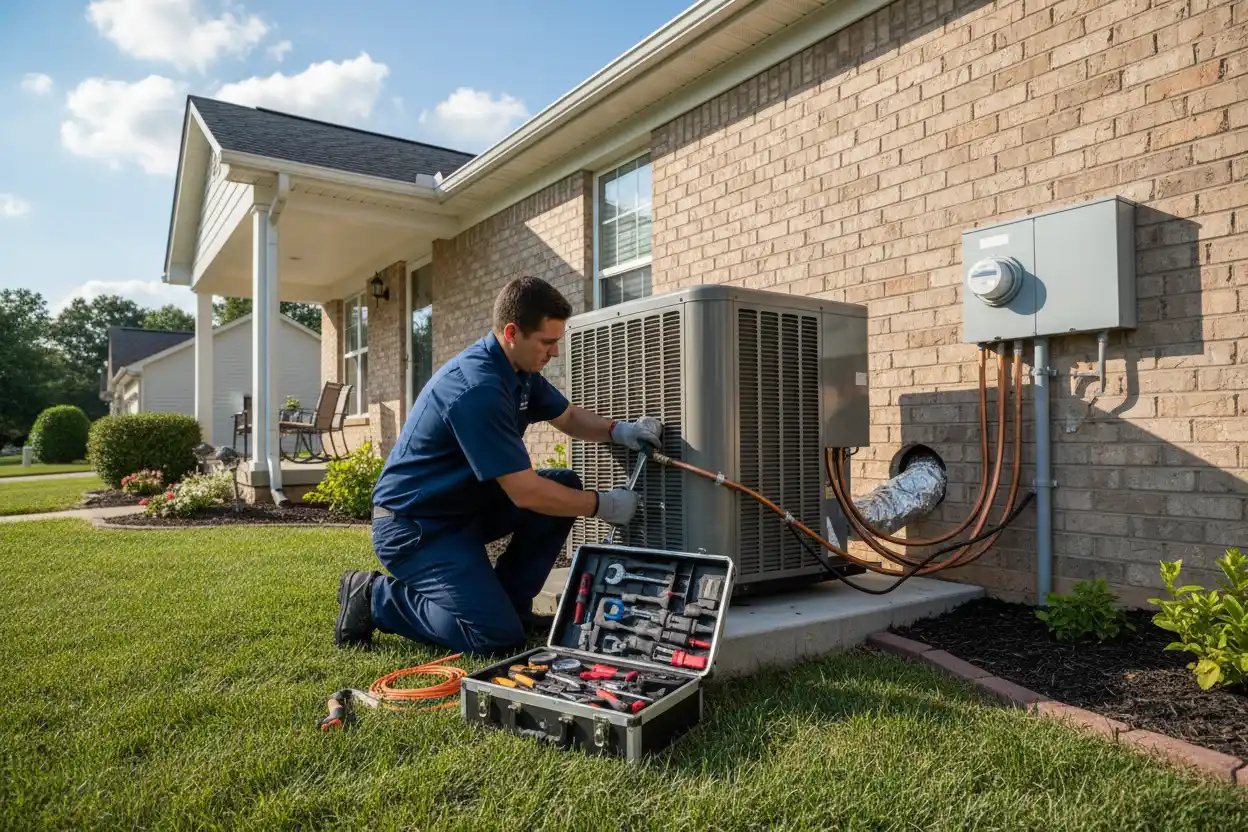
Replacement labor includes far more than carrying out the old condenser. Technicians recover refrigerant, remove equipment, connect indoor and outdoor components, work on electrical systems, prepare refrigerant piping, evacuate the system, configure controls, adjust airflow, and verify operation.
This is why two homes using the same model can receive different installation quotes. Equipment price stays similar, but the work required to install it does not.
Permits, Disposal, and Controls Belong in the Quote
A complete project budget accounts for the smaller charges that sit around the equipment itself.
Permit and inspection fees depend on local requirements. Old-equipment removal and lawful disposal should appear in the contractor’s scope. A deteriorated condenser pad, new thermostat, zoning control, drain modification, line-set cover, or code correction adds further cost.
These additions should not appear as surprises after installation begins.
Ask the contractor to separate required work from optional upgrades. That makes it easy to see whether a higher proposal reflects necessary project scope or extra features you did not request.
Repair Still Makes Sense When the Failure Is Limited
A broken central air conditioner does not automatically need replacement. Capacitors, contactors, fan motors, controls, drain components, and other failures cost far less than a new system.
A repair becomes especially attractive when the existing AC remains relatively young, has a strong service history, and needs one isolated component. Checking the expected central air conditioner repair cost against the replacement quote prevents a repairable system from being discarded too early.
The calculation changes after repeated failures or an expensive major-component problem. At that point, comparing AC repair with replacement puts the current invoice beside the system’s age, reliability, efficiency, remaining life, and replacement value.
A Heat Pump Deserves a Look When Heating Equipment Is Also Aging
Replacing central AC creates an opportunity to reconsider the entire heating and cooling setup.
A heat pump cools the home in summer and provides heating by reversing the refrigeration cycle. For a homeowner who also expects to replace aging heating equipment, one heat-pump project changes the financial comparison.
The relevant number is not the condenser price. The comparison includes indoor equipment, ducts, electrical capacity, controls, climate requirements, backup heating, and installation scope.
Reviewing the likely heat pump installation cost alongside the AC proposal gives a clearer picture when both heating and cooling are part of the long-term plan.
Ductless Cooling Solves a Different Problem
Central AC depends on ductwork. A home without usable ducts faces a much larger project if central cooling requires a new distribution network.
Ductless mini-splits deliver conditioned air directly through individual indoor units. Their cost depends on zone count, equipment capacity, line routing, electrical work, controls, and indoor-unit placement rather than a central duct network.
For a home that already uses ductless equipment, an expensive breakdown creates its own repair decision. Comparing mini split repair with replacement gives a more accurate financial picture than applying central AC replacement numbers to a different type of system.
Installation Quality Determines Whether the New System Delivers Its Rated Performance
A high-efficiency air conditioner installed on leaking ducts with poor airflow does not perform like a properly installed high-efficiency system.
Correct equipment sizing, indoor and outdoor component compatibility, refrigerant-system preparation, airflow adjustment, drainage, controls, and commissioning all affect the result.
The contractor should verify operation after installation rather than simply confirming that cold air comes from the vents. Final testing should establish that the equipment, airflow, controls, and refrigerant circuit operate as intended.
This is where an apparently higher quote can represent better value. The homeowner is paying not only for a box of equipment but also for the work required to make that equipment function correctly in the house.
Maintenance Starts After the Replacement Is Finished
A new central air conditioner still needs routine care. Filters, coils, condensate drains, controls, electrical components, outdoor equipment, and airflow all influence long-term performance.
Budgeting for central air conditioner maintenance keeps preventive care separate from emergency repairs and the initial replacement investment.
Professional service visits serve another purpose. A technician inspects, tests, cleans, adjusts, and diagnoses the system based on its condition. Understanding the expected central air conditioner service cost helps homeowners plan for that recurring professional attention after installation.
How to Compare AC Replacement Quotes Line by Line
Do not compare two HVAC bids until you know they include the same work.
A complete comparison checks the exact indoor and outdoor models, cooling capacity, efficiency rating, compressor type, thermostat, refrigerant-line work, electrical work, duct modifications, permits, old-equipment removal, system startup, commissioning, equipment warranty, and labor warranty.
If one contractor includes duct corrections and electrical work while another excludes them, the lower total is not the cheaper version of the same project. It is a different project.
Three detailed quotes provide a stronger pricing picture than three headline totals. Ask every contractor to list exclusions in writing before choosing between them.
Conclusion
A standard central air conditioner replacement costs $5,000 to $10,500, with a 3-ton system landing near $8,500 installed as a useful national benchmark. The strongest quote combines correct sizing, compatible indoor and outdoor equipment, sound ductwork, suitable electrical infrastructure, clear project scope, and proper commissioning. Compare complete installations rather than condenser prices, and identify duct, electrical, line-set, permit, and indoor-equipment work before the old system comes out.
Frequently Asked Questions
Does central AC replacement include new ductwork?
No. A standard replacement assumes the existing ducts remain usable. Significant duct repair or replacement adds a separate project cost. A ductwork inspection identifies leakage, damage, sizing problems, and airflow issues before the new AC is installed.
Can I replace only the outside AC unit?
Only when the existing indoor equipment is compatible with the new condenser. The indoor coil, blower, refrigerant requirements, controls, efficiency match, and manufacturer specifications all need to align with the outdoor unit.
How much does a 3-ton central air conditioner cost?
A 3-ton central air conditioner costs about $8,500 installed as a national planning benchmark. Equipment efficiency, brand, local labor, indoor components, and installation complexity move the final quote above or below that figure.
Should the new AC have the same tonnage as the old one?
No automatic rule says it should. The contractor should size the new system from the home’s current cooling load. Insulation upgrades, window changes, additions, air sealing, and duct modifications alter the amount of cooling the house needs.
Is a high-efficiency AC worth the higher price?
Higher efficiency makes the strongest financial case in homes with long cooling seasons, high electricity use, and enough ownership time to benefit from lower operating costs. Installation quality and correct sizing remain more important than buying the highest rating available.
Should I replace the furnace when I replace the air conditioner?
Replace the furnace only when its condition, compatibility, reliability, or remaining service life justifies the additional work. A healthy compatible furnace can remain in service. If the heating system has a specific mechanical problem, reviewing furnace repair costs keeps that decision separate from the cooling replacement.
What should I compare in central AC replacement quotes?
Compare model numbers, capacity, efficiency, indoor components, controls, ductwork, electrical work, refrigerant-line scope, permits, old-equipment removal, commissioning, exclusions, and warranties. The lowest total only represents a better price when the contractors are quoting the same project.
